Curatorial Statement
In March 2020, the world stood still as businesses and schools around the world closed in response to the global pandemic. Broadcast media, health, and government officials repeated the daily mantra “Flatten the Curve.” Resources became scarce, exposing health disparities and access issues that Native American families face across North America. Here in N’Dakinna (our homeland) Abenaki families turned to traditional medicines and other cultural practices for comfort and survival, connecting with nature and small family groups.
Throughout the dark times that followed, Abenaki and other Native American artists, musicians, and community members expressed the impact of the pandemic on ourselves and our community through storytelling, visual arts, and writing. Our stories of personal experience and perceptions about the disparities, access issues, and historical traumas that contribute to vaccine hesitation are also stories of recovery, survival, and resilience.
The stories and artwork in this exhibit were gathered by the Vermont Abenaki Artists Association through the Abenaki Storytelling Project to create an auto-history of the Native American community in Vermont and the surrounding environs.
Many of the storytellers, artists, and community members who contributed to this body of work found that sharing helped them process their grief. This exhibition goes beyond differences to speak of experiences that are universal. Together, we move Beyond the Curve.
Waolowzi (be very well),
– Vera Sheehan, Curator
Gallery Views & Sharing Events


 Exhibition Venues
June 17 – October 15, 2023 –Lake Champlain Maritime Museum in Vergennes, VT
October 21, 2023 – January 6, 2024 – Mad River Valley Arts, Waitsfield, VT
June 7 – July 18, 2024 – Chaffee Arts Center, Rutland, VT
Indigenous Voices
This portion of the digital exhibit includes a collection of snippets from individual storytelling sessions.
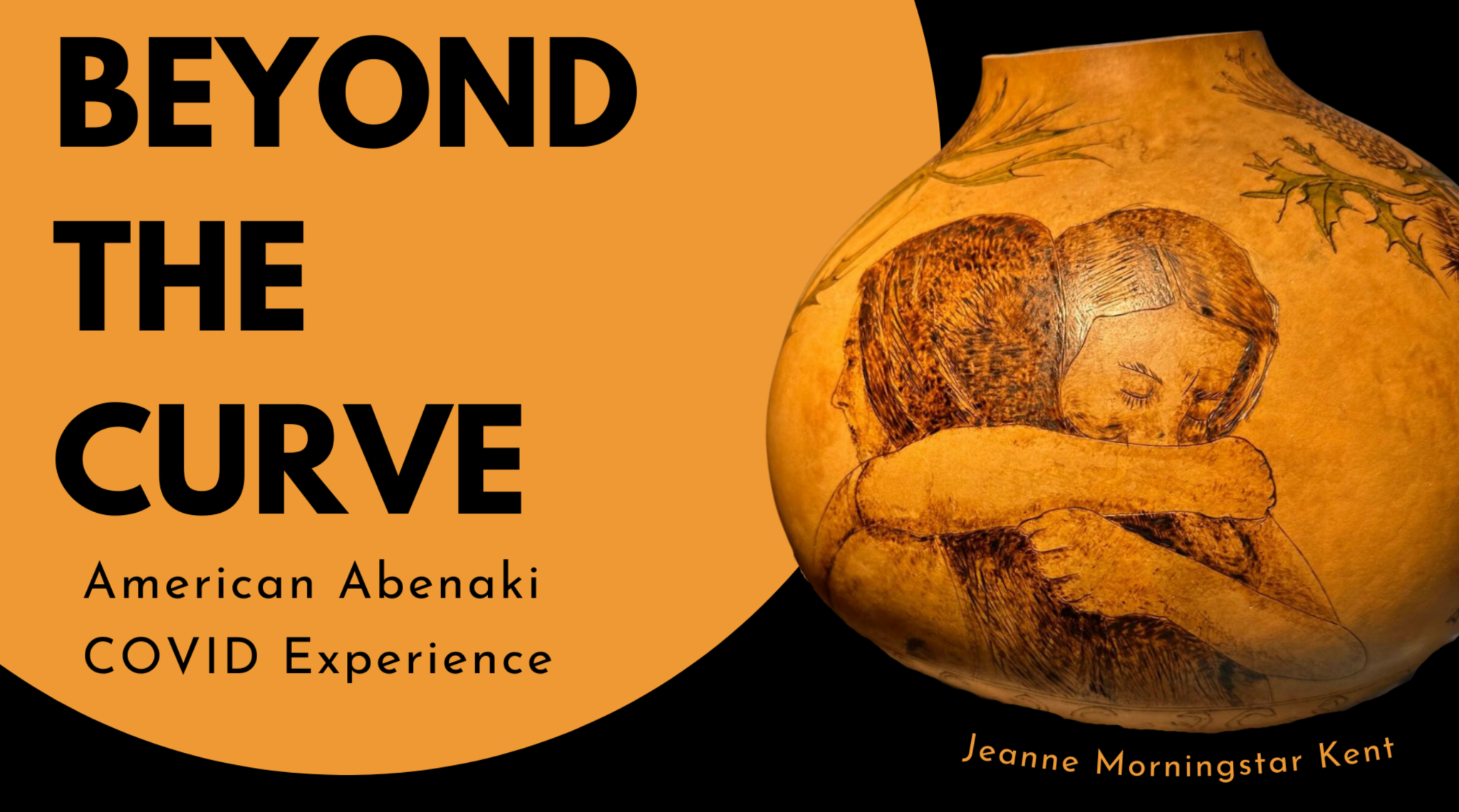
Artist Jeanne Morningstar-Kent describes her experiences… during the COVID pandemic… and the artwork she created as a tribute… to her sister.
Learn what the barbed-wire represent on this Mask.
Andrea Tamburro, EdW,MSW (Piqua Shawnee) advises how professional helpers can assist Indigenous populations dealing with Intergenerational trauma. Andrea has extensive teaching and research experience in both Indigenous and non-Native settings.
Our Stories
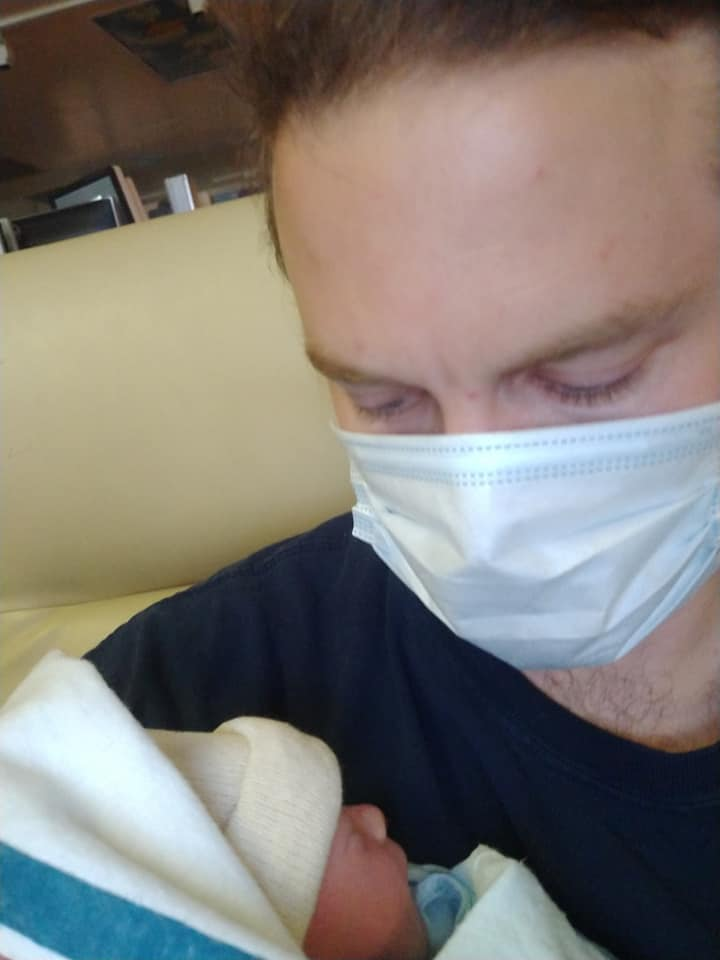
Father holding his baby for the first time.
Nizwiak (translated “my wife”) had an appointment for prenatal care at the hospital 5 weeks before her due date, one of the few she had at the hospital. She was rushed to the Mother/Baby unit with severe pre-eclampsia. Her frequent telehealth checkups did not catch the warning signs; headaches, vision changes, etc… He was born with no doctor in the room. A passing nurse and I caught him after Nizwiak’s second push…. So many things fell through the cracks during the pandemic.
— Story and image courtesy of Aaron W.
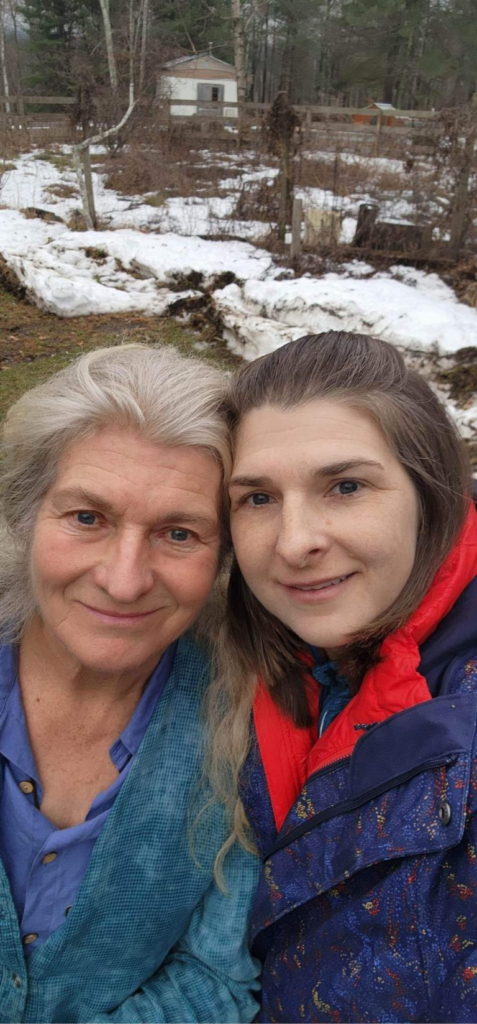
I am grateful to include my family’s story… I need positive creative projects to help me through my grief pathway.
– Kate A
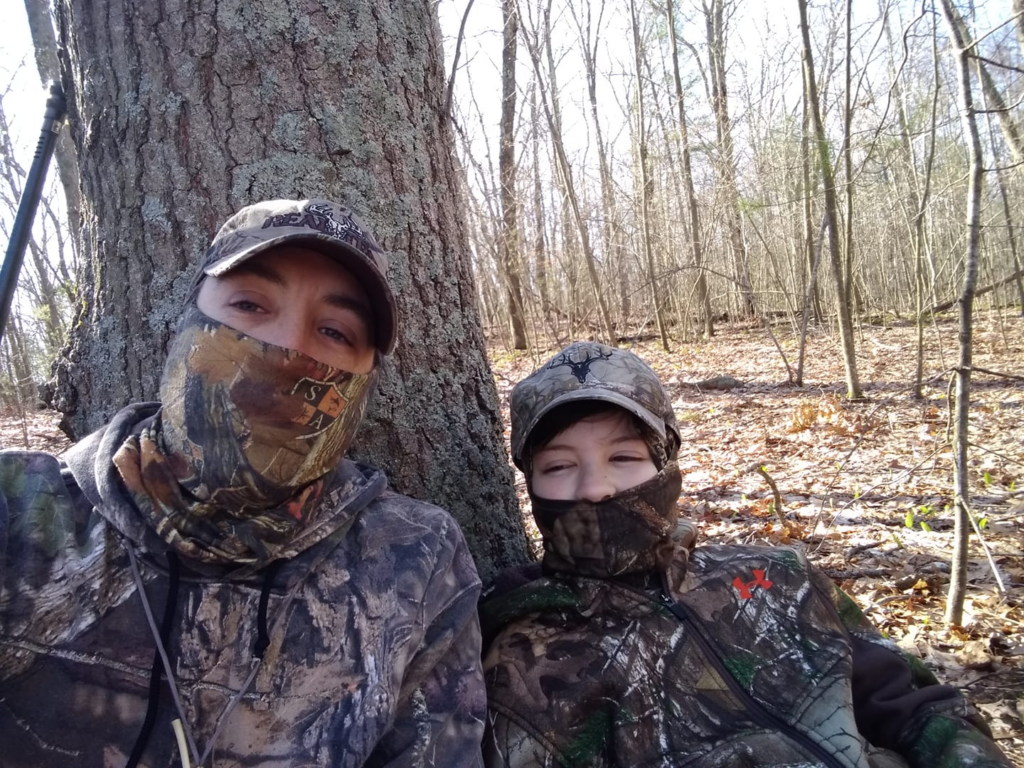
This is a picture of my son and me hunting in the woods of Central Massachusetts. We were looking for some culturally significant activities that we could do while still social distancing from others. Notice the turkey wing bone bird call hanging from my neck.
–Story and image courtesy of Brian C
Beyond the Curve at Chaffee Art Center
Chaffee: It’s All About the Arts – PegTV. June 2024
Sherri and Stephanie talk to Vera Longtoe Sheehan from the Elnu Abenaki Tribe about the current exhibit; Beyond the Curve: the Abenaki COVID Experience. This exhibit has amazing artwork created by Abenaki Tribe members of their experience thru COVID.
Methodology
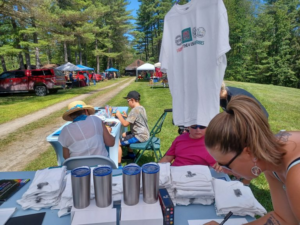 Memory booth at Nulhegan Abenaki Heritage event
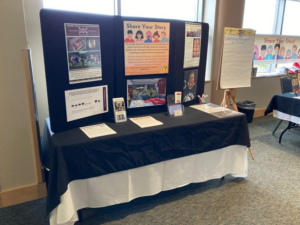 Memory booth at 2022 UVM Health Equity Summit
 Mask painted by Memory Booth participant
 Social media post introducing the project
 Invitation for community members to participate in the Memory Booth project
 Call for artists that was posted to social media
 Social media post requesting masked images

Artwork produced by a child, using the black scratch art method, to express their feelings about how COVID affected them
How we developed this exhibit
This exhibit was the culmination of a multi-year project to empower Native American people by collaborating with them to document their experiences during the global COVID-19 pandemic and come together in healing.
The resulting traveling exhibit was crowd sourced. It featured works of art by more than 12 American Abenaki and one Wampanoag artist from the region. Additionally, it was informed through inclusion of anonymous excerpts from storytelling sessions, scratch art, painted masks, and written testimony gathered at Memory Booths, artwork created as a result of calls to artists, and the inclusion of family photos. Participation was voluntary and based on free and informed prior consent.
Photos: The images on the left include a selection of some of the social media posts about the project and the environments in which content was created. Courtesy of Vermont Abenaki Artists Association.
Featured Artists
Charlie A. (Elnu Abenaki)
Kate A. (Abenaki descent)
Rhonda Besaw (Canadian Metis/Abenaki)
Vicki Blanchard (Nulhegan Abenaki)
Michael Descoteaux (Nulhegan Abenaki)
Bill Gould (Nulhegan Abenaki)
Sherry Gould (Nulhegan Abenaki)
Francine Poitras Jones (Nulhegan Abenaki)
Nathan Johnson (Nulhegan Abenaki)
Jeanne Morningstar Kent (Nulhegan Abenaki)
Bernie Mortz (Nulhegan Abenaki)
Julia Marden (Aquinnah Wampanoag)
Linda Longtoe Sheehan (Elnu Abenaki)
Hawk Schulmeisters (Elnu Abenaki)
Paul Rene Tamburro (Nulhegan Abenaki)
Amy Hook Therrien (Koasek of the Koas Abenaki)
Aaron York (Missisquoi Abenaki)
Gabrielle Zinn (Nulhegan Abenaki)
This exhibition also included crowd-sourced artworks created at public sharing events by Native (Mi’kmaq, Lenape, Mohawk, Native descent), as well as non-Native participants. All participants were given the option to remain anonymous.
Exhibition Visitor Feedback
I wanted to send a thank you for your invitation to the exhibit at LCMM. It was so powerful and healing to see the exhibit and hear the artists speak about COVID’s impact on their art and lives. I think there is still so much healing for us to do as we emerge from the pandemic. I hope other artists and organizations will have the courage and space to share pieces like these.
A very moving exhibit. Understanding the issues indigenous peoples had with the medical profession through Eugenics, explains the mistrust of vaccinations during COVID.
I discovered that the residential school wampum belt could be showing coffins and not beds… Significant. It helps me understand why there was vaccine hesitancy.
Background Information
“Throughout the pandemic, our experiences working with the many diverse populations that make up Vermont have helped us to better understand how gaps in our cultural understanding can impact individual and public health,” said Health Commissioner Mark Levine, MD.
How we crowd sourced this exhibit:
It all began with the Abenaki COVID-19 Storytelling Project
The Abenaki COVID-19 Storytelling Project was a community-based art project that supports Native American strength and resiliency. Over the past several years, the Vermont Abenaki Artists Association has sponsored several exhibits to promote the constantly evolving story of the lives of the Abenaki in N’Dakinna (our homeland). We utilize Native American arts and storytelling to uplift regional Abenaki voices and perspectives in museum exhibitions, programs, and cultural heritage events. When people see themselves reflected in exhibitions, artwork, and programs it is good for the health and wellness of their community by giving them a voice, which helps them know that their history, culture, and memories are important; they are not alone, especially during a time such as the recent pandemic.
The focus of 2022 – 2024 Storytelling Project explores how COVID-19 has affected the Abenaki community. Utilizing arts and storytelling, Vermont Abenaki Artists Association (VAAA) measured insights on COVID-19, vaccine-related perceptions, disparities, and access among the Native American population in Vermont and throughout N’Dakinna. These insights were shared with the community of origin and the public through a traveling exhibition and this online digital exhibition.

Contact
For more information about the Abenaki COVID-19 Storytelling Project, email [email protected] and type Storytelling Project in the subject line.
Project supported in part by: